 English
Views: 0 Author: Site Editor Publish Time: 2026-05-22 Origin: Site
For modern agribusinesses, the harvest window represents a highly critical, high-risk period. Labor shortages and unpredictable weather patterns can easily devastate entire crop yields in a matter of days. Relying on seasonal manual labor or outdated, inefficient machinery is simply no longer viable. Today's commercial operations require advanced, multi-functional fleets. Farm managers must consolidate reaping, threshing, and cleaning into a single, highly efficient pass.
Evaluating a heavy-duty combine harvester is a major capital decision for any farm operation. This guide breaks down essential performance metrics and analyzes crop-specific adaptations for rice versus wheat. You will discover actionable strategies for loss mitigation and equipment integration. By examining these core operational factors, farm operators can make a highly informed, evidence-based procurement decision. You will secure your harvest timeline and maximize profitability.
Single-Pass Efficiency: Modern machines have increased throughput to 15.0+ tons/hour while dropping fuel consumption to roughly 9 liters/hectare.
Crop-Specific Engineering: Harvesting rice requires different wear-resistant components and headers compared to wheat due to rice's abrasive silica content.
Loss Mitigation: Advanced threshing mechanisms can reduce post-harvest grain loss from historical averages of 4.5% down to sub-1.0%.
Fleet Integration: Harvesters now serve as data-gathering hubs, integrating with precision ag tools like yield-mapping software and aerial drones.
Labor costs are rising sharply across the global agricultural sector. The availability of reliable seasonal harvest crews is increasingly volatile. You cannot afford to build your business model around unpredictable manual labor. Delaying your harvest carries massive financial risks. Harvesting past peak crop maturity introduces several severe threats. It significantly increases the likelihood of grain shattering in the field. It also exposes vulnerable crops to weather damage and rapid moisture degradation.
Investing in a modern agricultural harvester solves these core challenges directly. It consolidates four distinct, linear steps into one seamless, continuous operation. This consolidation drastically reduces field time. We can break down this mechanized workflow into four key stages:
Cutting (Reaping): The front header severs the crop stalk at the optimal height.
Threshing: High-speed rotating drums separate the valuable grain from the stalk.
Cleaning: Engineered airflows and vibrating sieves remove unwanted chaff and debris.
Storage: Clean grain rapidly transfers into an onboard holding tank for transport.
A successful machine investment must achieve specific operational benchmarks. It must demonstrably offset rising labor wages. It should eliminate bottlenecks caused by managing multiple disparate pieces of equipment. Finally, it must maintain strict grain quality standards from the field straight to the storage silo.
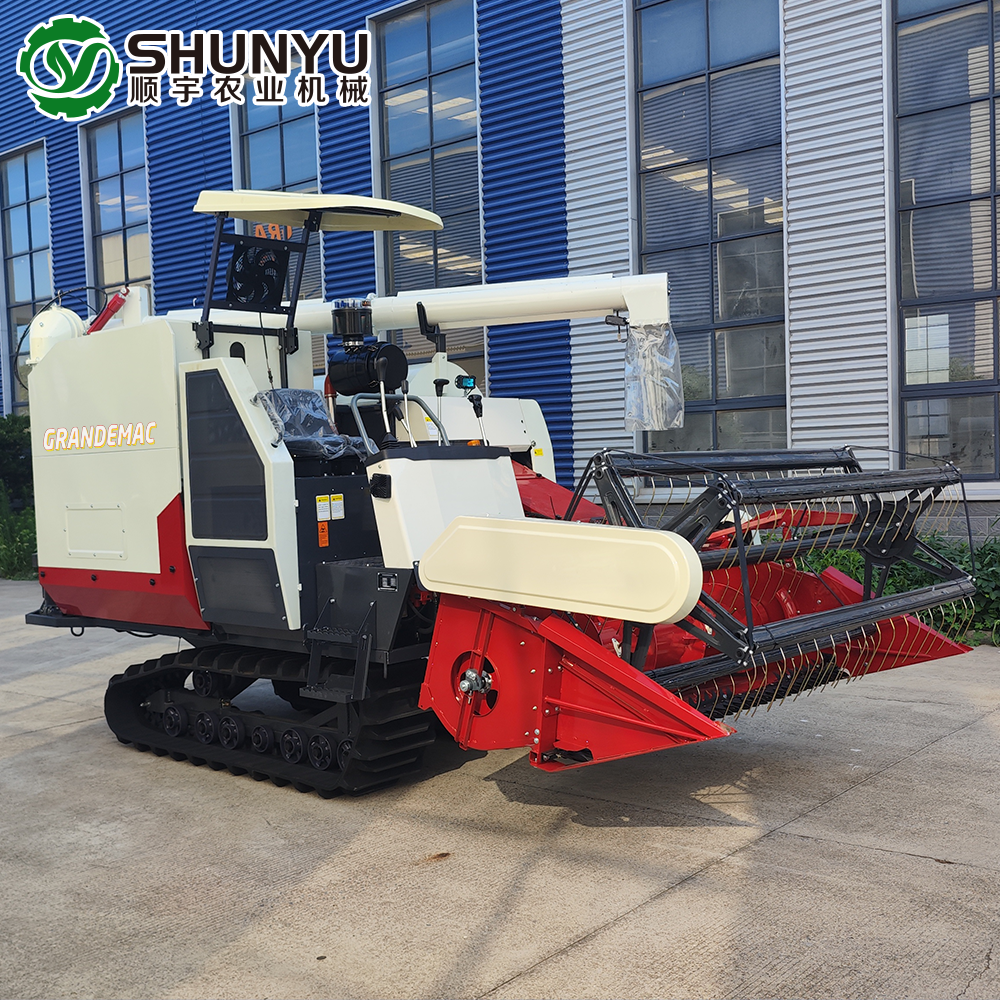
Many farm operators face a complex "multi-crop" challenge. One machine can theoretically harvest multiple grain types across different seasons. However, achieving optimal efficiency requires specific mechanical adjustments. You must adapt the machine based on crop physiology. Wheat and rice demand vastly different mechanical handling.
Wheat crops generally grow on firm, flat terrain. They exhibit highly consistent crop heights across the field. This uniformity makes harvesting relatively straightforward. You typically utilize rigid or flex headers for this application. These headers sweep evenly across standard, dry topographies. Wheat grains also separate easily from their husks upon impact. They require standard threshing drum configurations. You rarely need heavily modified internal components to achieve clean wheat separation.
Rice presents a much harsher mechanical environment. Rice stalks contain very high levels of silica. This mineral acts exactly like coarse sandpaper on machinery internals. It demands specialized, highly durable combine harvester parts. You must specify premium-line wear-resistant components to avoid rapid internal degradation.
Threshing adjustments remain equally critical. Rice needs a gentle "combing" action rather than aggressive blunt impact. Evaluating a dedicated rice harvester means inspecting its core internals. Look for specialized spike-tooth concaves. They strip the grains effectively without cracking the delicate outer hull. Header variations matter greatly here. Short headers or specialized draper systems manage the heavy, dense flow of wet rice crops. They prevent the intake system from jamming in extreme high-moisture conditions.
Equipment procurement requires analyzing hard, verifiable numbers. You must compare historical performance benchmarks against modern machine capabilities. A contemporary wheat harvesting machine routinely processes over 15 tons per hour. This massive speed advantage drastically shortens the critical harvest window. It protects your yield from sudden weather events.
Fuel efficiency plays a dominant role in your financial returns. You must strictly assess fuel burn rates per hectare. Recent technological advancements have effectively halved fuel consumption compared to older legacy models. This efficiency yields massive operational savings over a typical ten-year equipment lifecycle. These savings often justify the initial capital expenditure alone.
Minimizing post-harvest loss serves as another critical financial driver. Demand verified field data before purchasing any unit. Top-tier machines keep average post-harvest grain loss extremely low. They often operate below 2-3 kg per hectare under optimal conditions. You must understand the loss split to calibrate your machine properly. Header loss involves valuable grain dropping onto the ground before entering the machine. Threshing and separation loss occurs when the machine blows good grain out the back alongside the waste chaff.
Here is a detailed comparison chart highlighting these transformative performance metrics:
Performance Metric | Legacy Equipment (Pre-2010) | Modern Equipment | Direct Impact on ROI |
|---|---|---|---|
Processing Throughput | 6 - 8 tons/hour | 15.0+ tons/hour | Halves field labor hours |
Fuel Consumption | Approx. 18 liters/hectare | Approx. 9 liters/hectare | Substantial long-term savings |
Average Grain Loss | Up to 4.5% | Under 1.0% | Maximizes sellable volume |
Loss Source Distribution | Poor threshing calibration | Mostly minor header shatter | Improves calibration accuracy |
Modern harvest equipment acts as a rolling data center. Contemporary machines come fully equipped with GPS routing and real-time moisture sensors. They actively create high-resolution yield maps as they move across the field. These maps directly inform next season's variable-rate fertilizer applications. You stop guessing and start applying nutrients exactly where they belong.
Automation and auto-steering deliver immediate operational benefits. Auto-steering heavily reduces operator fatigue during brutal 14-hour shifts. It prevents overlapping driving paths entirely. This precise movement reduces unnecessary soil compaction across your acreage. It also guarantees optimal header alignment for maximum intake efficiency at all times.
Cross-equipment synergies elevate your entire farm management methodology. The data collected during harvest does not exist in isolation. You can easily cross-reference it with pre-season field intelligence. For example, multispectral imagery gathered by an agriculture drone provides baseline crop health metrics. Early-season planting data from a rice transplanter tracks your exact row spacing. Combining these data sets creates a closed-loop precision farming ecosystem. You gain total, end-to-end visibility over your crop's lifecycle.
Selecting the right model demands a highly structured, logical approach. You must match the machine's capacity Class to your specific acreage. Look closely at engine horsepower and onboard grain tank capacity. Compare these figures against your total farm size and anticipated harvest timelines. Oversizing leads directly to wasted capital expenditure. Undersizing risks catastrophic crop spoilage due to prolonged harvesting schedules.
Next, evaluate the drivetrain and terrain requirements thoroughly. Muddy or shallow-water rice paddies present unique mobility challenges. They often mandate half-feed tracked undercarriages. Rubber tracks distribute the machine's heavy weight evenly to prevent sinking in deep mud. Conversely, dry and firm wheat fields easily support standard wheeled configurations. Wheels offer faster road transport speeds between disparate fields.
Finally, investigate the manufacturer's dealer network and parts availability. The most advanced machine is useless sitting idle in a shed. Breakdowns during peak season are financially devastating. Prioritize OEMs operating established local service hubs. They must offer rapid diagnostic capabilities for electronic faults. They should also maintain robust regional stockpiles of consumable combine harvester parts. Ensure you have immediate access to replacement belts, cleaning sieves, and cutting blades.
Transitioning to an advanced combine harvester is a definitive step toward insulating a commercial farm against labor shortages and climate volatility.
Success lies not just in buying horsepower, but in selecting the exact header type, threshing configuration, and telematic suite tailored to your specific crop.
Acknowledge the harsh mechanical reality of abrasive rice versus high-volume wheat. Specify wear-resistant components proactively to prevent mid-season breakdowns.
Consult with authorized dealers to run a farm-specific ROI calculation. Always factor in your current labor spend, average grain loss rates, and local soil conditions.
A: Yes, but it requires swapping out specific components. Operators must typically install spike-tooth concaves, adjust cylinder speeds, and potentially change the header to accommodate the high abrasiveness and moisture content of rice compared to wheat.
A: With strict preventative maintenance—including daily cleaning, automated lubrication, and off-season storage protection—a commercial harvester can operate efficiently for 10 to 15 years, though high-wear parts will require regular replacement.
A: Grain loss is generally divided into header loss (shattering at the cutter bar) and separation loss (grain expelled with the chaff). On modern machines, proper calibration can reduce total loss to well under 1.0%.


