 English
Views: 0 Author: Site Editor Publish Time: 2026-06-17 Origin: Site
The agricultural sector has officially moved past the novelty phase of early technology adoption. Today, aerial application equipment serves as a proven, highly practical tool for modern farm integration. These machines routinely handle complex field tasks, proving their worth during narrow weather windows. They represent a significant shift in how we approach crop health management.
However, selecting the right equipment demands looking far beyond glossy marketing brochures. You must navigate real-world payload limits, strict regulatory hurdles, and technical nuances. Ignoring these operational realities often leads to costly mistakes and sidelined equipment. You need a clear understanding of what these machines can and cannot do in your specific fields.
This article provides a realistic, productivity-focused framework for evaluating, shortlisting, and implementing these advanced systems without underestimating compliance requirements. We will explore how to assess payload efficiency, navigate aviation roadblocks, and select the right dealer support. You will gain actionable insights to confidently integrate these machines into your daily workflow.
Payload vs. Productivity: A larger tank isn't always better; operational efficiency depends on battery cycling, swath width, and mixing turnaround.
Regulatory Roadblocks: Legal operation requires specific aerial applicator licenses (e.g., FAA Part 137 in the US) and strict adherence to drift management protocols.
Dealer Support > Brand: Localized technical support, parts availability, and training are critical deciders for minimizing downtime during narrow application windows.
Farmers often wonder if they should completely replace their current machinery. The reality is quite different. A crop spraying drone rarely replaces a massive self-propelled ground rig. Instead, it serves as a highly specialized augmentation tool. It fills the operational gaps left by traditional equipment. You can use it to supplement traditional aerial applicators or enable precise spot-spraying in hard-to-reach areas.
The true value emerges when you examine specific terrain and field conditions. These machines unlock application windows previously closed to heavy tractors. High-value use cases typically include the following scenarios:
Post-rain applications: Heavy tractors cause deep soil compaction and ruts in muddy fields. Drones fly directly over wet ground, ensuring you never miss a critical fungal or pest treatment window.
Steep topographies: Terraced farms and steep hills present severe rollover risks for ground rigs. Aerial tools handle dangerous inclines effortlessly.
Tall canopy crops: Late-season corn, dense orchards, and mature sunflowers make ground entry difficult. Drones apply chemicals from above without snapping stalks or damaging the harvest.
Another major advantage involves chemical savings through precision. Traditional broadacre broadcast methods apply uniform rates across an entire field. In contrast, aerial tools enable variable rate application (VRA). You can target specific weed patches or disease zones identified by mapping software. Spot-spraying significantly reduces chemical usage, directly improving your operational efficiency.
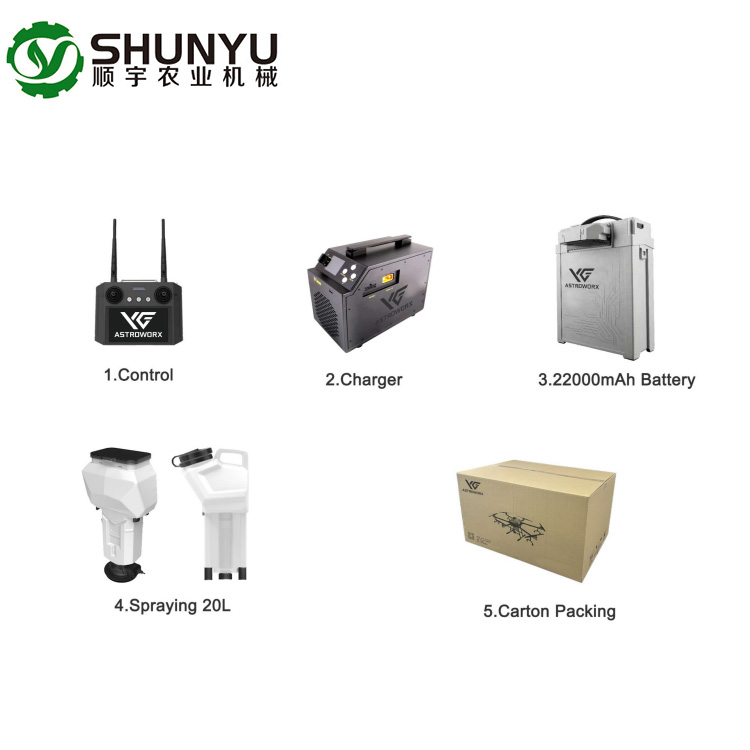
When you start shopping, you will encounter diverse technical specifications. Selecting the right agricultural drones for spraying requires aligning the hardware capabilities with your specific acreage and crop types. It helps to break these specifications down into practical evaluation categories.
Manufacturers generally categorize models by their liquid payload capacity. Small models carry between 10 and 20 liters. Heavy-lift models carry 30 to over 50 liters. A 10-liter plant protection drone excels at spot treatments and small orchards. It maneuvers easily and requires less logistical setup. Conversely, heavy-lift models handle broadacre coverage but demand robust transport and mixing infrastructure.
You must adjust manufacturer claims regarding "acres per hour." Marketing materials often state optimal figures. Real-world productivity depends heavily on field shape, ferry times, and refill speeds. If your mixing station sits far from the flight zone, long ferry flights will drain batteries quickly. A large tank means nothing if you spend ten minutes refilling it.
Payload Category | Ideal Application | Maneuverability | Logistics Requirement |
|---|---|---|---|
Small (10L – 20L) | Spot spraying, small plots, steep hills | High | Low (Basic mixing setup) |
Medium (20L – 30L) | General farm augmentation, orchards | Moderate | Medium (Trailer & pumps needed) |
Heavy (30L – 50L+) | Broadacre coverage, high-volume application | Low | High (Industrial generators, large tanks) |
The delivery mechanism determines how effectively you coat the target. You must choose between centrifugal atomizing nozzles and standard pressure nozzles. Your choice depends entirely on chemical viscosity and required droplet size.
Standard pressure nozzles push liquid through a restricted orifice. They work well for standard herbicides. However, thick suspensions and heavy fertilizers easily clog them. Centrifugal nozzles solve this problem. They drop liquid onto a rapidly spinning disk, shearing the fluid into uniform droplets. You can adjust droplet size mid-flight by changing the disk's rotational speed. This prevents clogs when applying thick biologicals.
You also need to understand the downwash effect. Rotor configuration significantly impacts canopy penetration. The spinning propellers create powerful downward air currents. This turbulent air pushes the spray deep into the crop canopy. It flips leaves, ensuring the chemical coats the undersides where pests usually hide. Proper downwash management maximizes chemical efficacy.
Modern units fly themselves. You map the boundaries, and the software executes the grid. However, farm environments present numerous obstacles like power lines, trees, and changing elevations. Evaluating obstacle avoidance systems is critical.
Radar systems bounce radio waves off objects. They perform exceptionally well in dusty environments and low light. Binocular vision systems use cameras to calculate depth. They struggle in heavy dust or glare but offer excellent detail in clear conditions. The best units combine both technologies.
Furthermore, Real-Time Kinematic (RTK) positioning is an absolute necessity. Standard GPS drifts by several meters. RTK technology connects to ground-based stations to provide centimeter-level accuracy. This precision keeps the aircraft exactly on its flight line. It prevents chemical overlap, avoids missed strips, and ensures you stay strictly within the legal field boundaries.
Legal compliance remains the highest barrier to entry. Operating a commercial farm UAV requires navigating a complex, dual-layer regulatory environment. You cannot ignore these rules without risking severe fines and liability.
In the United States, you must deal with both aviation and pesticide laws. First, you need an FAA Part 107 remote pilot certificate. Then, because these machines dispense chemicals and weigh over 55 pounds, you must secure an FAA Part 137 aerial applicator certificate and specific heavy-drone exemptions. Simultaneously, state-level Departments of Agriculture require commercial pesticide applicator licenses. Each state enforces its own testing and reporting rules.
Mitigating spray drift represents a critical daily reality. Wind limitations dictate when you can fly. Software parameters must align perfectly with local pesticide label requirements. You control drift by lowering flight altitude, reducing flight speed, and increasing droplet size. Finer droplets drift miles away, potentially destroying a neighbor's sensitive crop. Coarse droplets fall faster and stay on target.
Finally, navigate insurance requirements carefully. Standard farm liability policies rarely cover aerial chemical application. You need specialized commercial UAV policies. These must include hull insurance for the equipment itself and comprehensive chemical drift coverage to protect against accidental off-target damage.
Finding the right hardware is only half the battle. Your choice of dealer dictates your long-term success. Many buyers make the mistake of direct-importing equipment to save on the upfront price. This strategy often backfires during peak application season.
When evaluating an agriculture drone, prioritize local dealer infrastructure. If a pump fails or a rotor arm cracks during a narrow three-day spray window, you cannot wait two weeks for overseas shipping. A localized distributor keeps replacement parts on hand. They provide immediate technical support. This regional backing minimizes downtime when every hour counts.
Next, evaluate the depth of handover training. A quality supplier does not just hand over the boxes. They provide comprehensive onboarding. This training should cover emergency flight procedures, detailed maintenance routines, and mapping software familiarization. You must know how to clean the pumps, calibrate the compass, and manually override the autonomous system if a sensor fails.
Before committing, demand a physical demonstration. Create a strict checklist for this field demo to ensure the machine handles your specific realities:
Test terrain following: Force the unit to fly over your actual slopes and uneven ground to verify radar responsiveness.
Verify battery logistics: Time how long it takes to land, swap the battery, refill the tank, and relaunch. This reveals your true turnaround time.
Check pump performance: Ask the dealer to run water through the system. Observe the spray pattern consistency and check for any nozzle dripping after the pump shuts off.
Assess the software: Watch the dealer map a complex field boundary. Note how easily the interface handles no-fly zones and obstacles.
Successfully integrating aerial application equipment requires a disciplined, practical approach. You must build a clear decision-making framework. Align the payload capacity with your total acreage and topographical challenges. Acknowledge the operational logistics involved in keeping these machines flying continuously. More importantly, secure all necessary regulatory clearances and licenses well before the spray season begins.
We highly recommend scheduling a localized field demonstration. Consult with a certified regional dealer to map out the specific logistical requirements for your exact crop types. Seeing the machine operate over your own terrain provides the clearest path to making an informed, highly productive equipment investment.
A: A standard 30L to 40L unit typically covers 25 to 40 acres per hour. However, this estimate heavily depends on field shape, application rate, and ferry distance. Efficient battery swapping and rapid tank refilling are essential to hit these numbers. Poor ground logistics will easily cut this productivity in half. Always adjust manufacturer claims based on your specific application volume and terrain layout.
A: No. You cannot simply buy a unit and fly it over a field. In the United States, commercial operation requires an FAA Part 137 certification, a Part 107 remote pilot license, and a heavy-drone exemption. Additionally, operators need state-level pesticide applicator licenses. Always check local chemical labels, as some explicitly prohibit aerial or drone application.
A: Most commercial smart batteries last between 300 and 500 charge cycles before noticeable degradation occurs. Extreme heat, deep discharging, and improper storage accelerate this decline. To maximize lifespan, operators should rotate their battery inventory evenly. Use water-cooled charging stations in the field. Never store batteries fully charged or completely depleted during the off-season.
A: Rarely. They primarily complement traditional ground rigs. While drones excel in wet conditions, rough terrain, and tall canopies, they lack the sheer volume capacity for massive broadacre applications. Tractors efficiently handle hundreds of acres quickly. Drones handle targeted spot treatments, late-stage canopy applications, and areas where heavy machinery would cause excessive soil compaction.


