 English
Views: 0 Author: Site Editor Publish Time: 2026-06-13 Origin: Site
Agricultural operations currently face rapidly shrinking labor pools. Tight planting windows make manual work unsustainable for mid-to-large-scale farms. Growers urgently need faster, smarter solutions. Mechanizing your planting process demands highly robust equipment. You need machinery balancing speed, fuel efficiency, and operational uptime in harsh wetland conditions. Older, low-capacity tools simply cannot keep up anymore. This guide breaks down the operational economics, mechanical requirements, and procurement realities of deploying these machines. We explore how to effectively scale your paddy operations today. You will learn how to evaluate precision, engine performance, and supplier credibility. This ensures you make the most profitable equipment decision.
Efficiency Gains: A riding 6-row model exponentially increases daily acreage coverage compared to walk-behind variants.
Diesel Advantage: Diesel engines provide superior low-end torque essential for muddy paddies, plus better fuel economy during 10-12 hour operational shifts.
Evaluation Focus: Procurement decisions should prioritize 4-wheel drive (4WD) stability, planting arm precision (minimizing missing hills), and aftermarket parts availability over baseline sticker price.
ROI Timeline: Break-even is typically achieved through labor reduction and higher seedling survival rates within 2-3 planting seasons for commercial growers.
Let us frame the transition from walk-behind units first. Walk-behind machines perform adequately in small plots. However, commercial operations demand significantly more output. Upgrading to a riding rice transplanter effectively prevents operator fatigue. It allows for consistent high-speed planting across massive hectares. You secure higher daily outputs safely. A seated operator maintains focus longer. They make fewer steering errors during long shifts.
Mechanized spacing optimizes crop yields directly. A typical 6 row planter maintains a precise 30cm row-to-row spacing. This standardized distance enhances field ventilation. It also maximizes sunlight penetration to the crop base. Better airflow reduces fungal diseases naturally. You give each rice plant adequate room to tiller. Stronger tillering directly correlates to heavier grain yields at harvest.
We must also quantify the labor shift accurately. Traditional methods require over ten manual laborers per hectare. Mechanization cuts this dependency drastically. You only need one trained operator and a single seedling loader. You standardize the planting pace perfectly. Weather conditions no longer dictate your daily progress.
Phase 1: Reassign manual laborers to nursery tray preparation.
Phase 2: Train a dedicated machine operator for field navigation.
Phase 3: Establish a continuous seedling supply chain to the field edge.
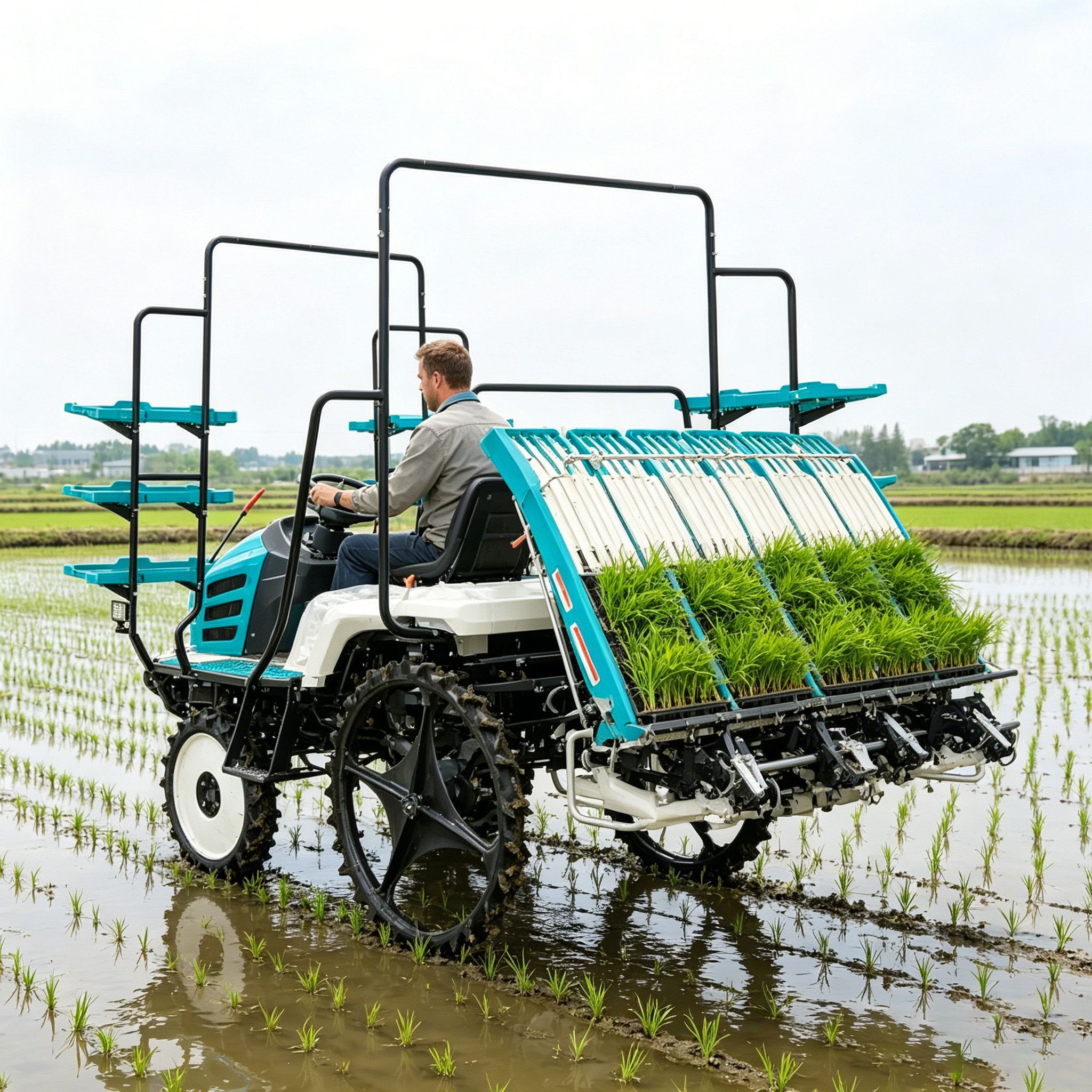
You might wonder why diesel outperforms petrol here. Deep, muddy terrains demand immense pulling power. A diesel engine planter delivers sustained low-RPM torque. This specific torque prevents the engine from stalling. It drives the four-wheel drive (4WD) systems through thick mud smoothly. Petrol engines often bog down under such heavy loads. Diesel provides the brute force needed to escape deep ruts.
Thermal efficiency matters during tight planting windows. Diesel engines run highly efficiently under load. Less frequent refueling means fewer operational interruptions. You can run 10 to 12 hour shifts easily. We know uptime directly correlates to farm profitability. Every hour spent refueling wastes valuable daylight.
Let us discuss durability in harsh environments. Paddy fields expose machinery to water, mud, and high humidity constantly. Diesel systems utilize robust sealed components. They feature simplified electrical systems compared to petrol engines. Fewer exposed electronics mean fewer short circuits. Your machine survives the grueling wetland conditions longer. Routine exposure to splashing mud barely affects a well-sealed diesel block.
Planting precision defines a successful machine entirely. We call this the "missing hill" metric in agriculture. A high-speed paddy planting machine remains viable only if it rarely misses a spot. Your target missing hill rate must stay below 3%. You should evaluate the rotary planting arm mechanisms carefully. Look closely at the stainless steel needle durability. Flimsy needles bend easily and drop seedlings.
Terrain adaptability requires careful assessment. Fields often have uneven hardpans hidden underwater. You need four-wheel drive and independent suspension systems. They maintain planting depth consistency everywhere. Consistent depth ensures uniform crop emergence later. If wheels slip, the planting claws bury seedlings too deeply.
Consider the adjustability features available. Look for on-the-fly adjustable depth controls. Variable hill spacing is equally important. Changing spacing from 12cm to 21cm accommodates different rice varieties. It adapts to varying soil fertility levels perfectly. A versatile chassis allows you to tweak settings instantly.
Weight distribution is critical for continuous operation. A well-balanced chassis prevents sinking. If your rice transplanter 6 row machine sinks in deep mud, progress stops. A loaded machine carries heavy seedling trays. Proper engineering distributes this weight evenly across the wide wheels.
Component | Minimum Requirement | Impact on Operation |
|---|---|---|
Planting Arm | Stainless steel needles, rotary mechanism | Keeps missing hills under 3% |
Drivetrain | 4-Wheel Drive (4WD) | Prevents sinking in deep mud |
Engine Type | Diesel (e.g., Yanmar, Laidong) | Provides necessary low-end torque |
Hill Spacing | Adjustable (12cm - 21cm) | Adapts to various rice cultivars |
Address the operator learning curve honestly. Operating at high speeds requires sharp spatial awareness. Drivers must align rows perfectly. Overlapping wastes valuable seedlings. Leaving gaps wastes productive field space. Training takes a few days initially. However, mastering the row markers pays off quickly. A skilled operator maximizes the daily hectare coverage.
Daily maintenance protocols remain strictly non-negotiable. We follow rigid daily checks on the farm. You must grease moving parts on the planting arms. You need to wash off corrosive mud daily. Inspecting diesel fuel filters prevents sudden engine failures. Ignoring these simple steps leads to expensive breakdowns in the field.
Wash the chassis thoroughly after every shift to prevent mud caking.
Apply high-grade grease to the rotary arm linkages daily.
Check tire pressures to maintain optimal buoyancy in water.
Drain water separators in the diesel fuel line weekly.
Seedling preparation dictates overall machine efficiency. You depend heavily on high-quality nursery trays. Standardized trays ensure smooth feeding into the machine. The equipment's efficiency is strictly bound by the mat-type seedlings. Poorly grown root mats cause frequent jams. You must align your nursery practices with the machine's specifications.
Evaluate long-term lifecycle expenses versus upfront pricing. We warn against making decisions based solely on platform listings. Cheap upfront prices often hide expensive replacement parts. Factor in the cost of consumable needles, drive belts, and estimated downtime. A slightly pricier unit often saves substantial money over five years.
Verifying B2B supplier credentials protects your capital investment. Look for quality certifications immediately upon contact. ISO or CE marks indicate standardized manufacturing processes. Differentiate between engine warranties and chassis warranties carefully. Engine OEMs usually cover the engine block itself. The implement supplier covers the planter body. Clarify these terms before signing any contracts.
Account for supply chain logistics and lead times. Manufacturing and shipping take considerable time globally. Plan well ahead of your upcoming planting season. Require documented proof of spare part dispatch speeds. You cannot afford to wait weeks for a broken belt. Ask suppliers about their local distributor networks. Rapid parts availability defines a good supplier.
A high-speed diesel transplanter represents a major capital investment. It stabilizes unpredictable labor costs directly. Precision mechanics maximize your crop yield reliably. You transition from unpredictable manual work to highly controlled farming. Mechanization guarantees you meet tight planting windows every season.
Here are your action-oriented next steps:
Request live field-test videos from potential suppliers in deep mud conditions.
Review technical parameter charts covering machine weight, engine torque, and planting speeds.
Audit local aftermarket support and replacement parts availability before purchasing.
Standardize your seedling nursery trays to match your chosen machine specifications.
A: A high-quality diesel machine generally operates between 0.5 to 1.5 meters per second. In practical terms, an experienced operator can cover approximately 0.3 to 0.5 hectares per hour. Speeds vary based on mud depth, field layout, and seedling reloading times.
A: Yes, but within specific mechanical limits. The machine relies on 4WD and wide tires for buoyancy. However, the field must have a solid hardpan beneath the mud. If the hardpan is deeper than 35-40cm, even the best machines risk sinking.
A: Rotary arms spin continuously, allowing for extremely high-speed, precise planting with minimal vibration. Crank-type arms use a traditional push-pull mechanical motion. While crank types are highly durable and cheaper to repair, rotary arms offer superior efficiency for large-scale operations.
A: You should perform daily checks on oil levels and air filters. A full service, including oil and fuel filter changes, typically occurs every 50 to 100 operating hours. Always refer to the specific engine OEM manual for exact maintenance intervals.


